
The Beauty of What Remains
Beauty in What Time Leaves Behind
We tend to associate beauty with things at their peak.
A flower in full bloom. A tree covered in fresh spring leaves. A garden overflowing with the colours and abundance of summer.
We celebrate beginnings, growth and flourishing. We photograph flowers when they are at their most magnificent, admire trees in their autumn colours and look forward to the first signs of spring.
But what happens when the flowers fade, the leaves fall and the garden begins to withdraw into winter?
Do we stop seeing beauty? Or have we simply learned to recognise only certain kinds of it?
Winter invites us to look again.
A dried seedhead, a curled leaf, a weathered branch — these are not merely the remains of something that was once beautiful. They possess a beauty of their own.
And sometimes, when the distractions of colour and abundance have fallen away, we discover something even more extraordinary.
The Architecture That Was Always There
Look closely at a dried flowerhead.
During summer, our attention is drawn to the colour of its petals, the insects visiting its flowers and the abundance of life surrounding it.
But as the flower fades, something remarkable happens.
Its underlying architecture becomes visible.
The delicate arrangement of stems, the intricate geometry of the seedhead, the patterns that once supported and protected its developing seeds.
Consider the dried flowerhead of a hydrangea. As its papery petals weather and decay, their delicate veins become increasingly visible. Sometimes the softer tissue disappears altogether, leaving a beautiful lace-like structure.
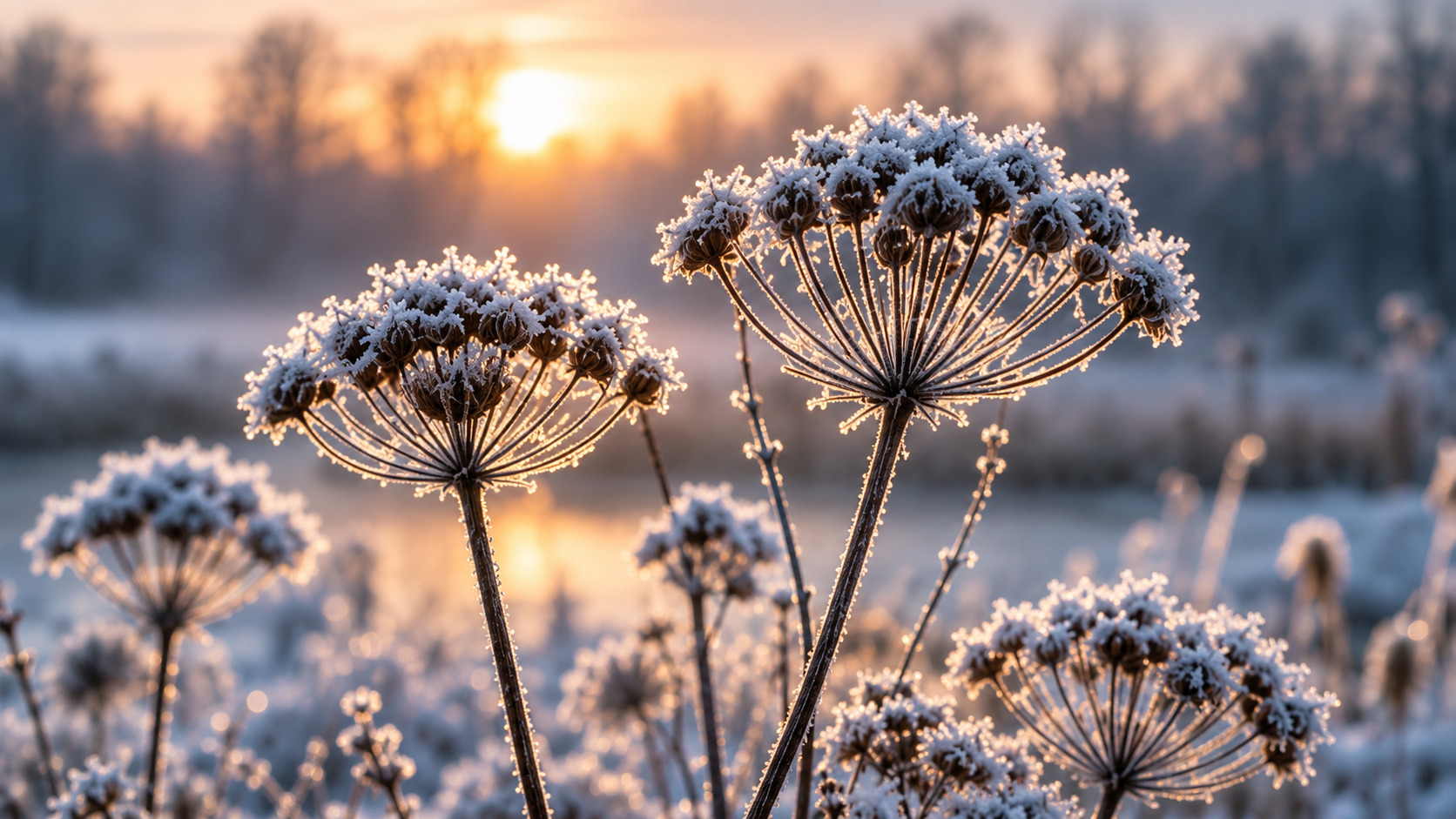
Or look at a teasel, its elongated seedhead covered in hundreds of tiny, carefully arranged structures. In winter, its distinctive form stands out against the bare landscape, particularly when outlined by frost.
These structures were present throughout the growing season. We simply paid more attention to other things.
There is something fascinating about this.
Sometimes beauty is not created by adding something, but revealed by taking something away.
The Extraordinary Beauty of Imperfection
We often think of beauty in terms of perfection.
An unblemished leaf. A symmetrical flower. A smooth surface untouched by age or weather.
Yet nature offers countless examples of beauty emerging through imperfection.
A leaf eaten by insects may develop an intricate pattern of holes. A branch twisted by years of wind can acquire a sculptural character. A fallen tree, slowly softened by fungi and moss, becomes a landscape of extraordinary textures.
In Japan, the aesthetic philosophy of wabi-sabi finds beauty in impermanence, imperfection and the marks left by time.
A weathered wooden surface, a cracked ceramic bowl or a faded piece of fabric may be appreciated precisely because it carries evidence of its history.
There is a similar quality in the winter garden.
The ragged edge of a leaf tells a story of wind, rain, insects and the passage of seasons. The worn bark of an old tree reveals something of the years it has endured.
These are not necessarily flaws to be overlooked.
They are part of what makes each object unique.
Perhaps the question is not whether something is perfect, but whether we are willing to see the beauty of what it has become.
A Hidden World Within a Seedhead
The dried seedheads that remain standing through winter are far more than decorative remnants.
Many are extraordinary examples of natural engineering.
Consider the umbellifer family, which includes plants such as cow parsley, wild carrot and angelica.
Their flowers are arranged in clusters called umbels, with individual stalks radiating from a central point, often creating an umbrella-like structure.
When the flowers fade, this architecture remains, supporting the developing seeds.
In winter, these delicate frameworks can become miniature sculptures, especially when outlined by frost or caught in low sunlight.
Other plants have evolved equally remarkable ways of protecting and dispersing their seeds.
The teasel produces a dense head containing numerous small seeds, which can provide food for birds, particularly goldfinches.
The poppy develops a dry capsule with tiny openings beneath its crown. As the stem moves in the wind, seeds can be shaken out and scattered.
The honesty plant produces flat, rounded seedpods. When the outer layers fall away, a translucent silvery membrane remains, giving the plant its familiar winter appearance.
What appears to be the end of a flower's life is often part of its continuing purpose.
The beauty we see is inseparable from the extraordinary processes that allow life to continue.
The Quiet Work of Decay
We sometimes think of decay as the opposite of life.
But in nature, decay is essential to life.
A fallen leaf does not simply disappear. It becomes part of an intricate process of transformation.
Fungi, bacteria and countless small invertebrates gradually break down its tissues. Nutrients are released and recycled through the soil, where they can become available to other living organisms.
The leaf that once captured sunlight and helped nourish a tree becomes part of the earth from which future growth will emerge.
Dead stems provide shelter for insects. Hollow plant stalks may become nesting places or winter refuges. Fallen branches offer habitats for fungi, beetles and other organisms.
Even a decaying tree can support an astonishing diversity of life.
In a healthy woodland, dead wood is not waste. It is an essential part of the ecosystem.
This changes the way we might look at a winter garden.
Rather than seeing fallen leaves and dried stems as untidiness to be removed, we can begin to recognise their continuing contribution.
The garden is not empty or inactive.
It is transforming.
What remains from one season helps make the next possible.
Learning to See Differently
There is an interesting distinction between looking and seeing.
We can walk past the same object hundreds of times without really noticing it.
Our minds are extraordinarily efficient at recognising familiar things. Once we have identified something as a leaf, a branch or a dried flower, we often stop paying attention.
We know what it is, so we assume there is nothing more to discover.
But recognition is not the same as observation.
Try looking at a dried leaf without immediately thinking of it as a leaf.
Notice the way its veins branch and divide. The subtle variations in colour. The edges that have curled as moisture has been lost. The small holes created by insects or decay.
Notice the shadows within its folds and the way light passes through its thinner surfaces.
You may discover an entire landscape of shapes and textures in something you would ordinarily walk past.
The object has not changed.
What has changed is the quality of your attention.
This is one of the central invitations of The Turning Year.
Not simply to learn more about the natural world, although there is endless fascination to be found there, but to rediscover our capacity to be surprised by what is familiar.
To approach the world with curiosity rather than assumption.
To see what is actually here, rather than what we expect to see.
What Remains in Our Own Lives
There is perhaps a deeper reflection hidden within the winter garden.
As we move through life, we experience our own changing seasons.
In youth, our attention may be directed towards growth, achievement, possibility and accumulation.
We build careers, relationships, homes and identities. We pursue ambitions and imagine the lives we hope to create.
But as the years pass, our priorities often begin to change.
Some ambitions lose their importance. Certain beliefs and assumptions fall away. Experiences reshape our understanding of ourselves and the world.
Things that once seemed essential may no longer matter quite so much.
And other things, perhaps overlooked for years, become increasingly precious.
A meaningful friendship. A quiet moment in nature. The freedom to be ourselves. The simple pleasure of being present.
There can be a kind of clarity that emerges when we no longer feel the need to carry everything we once believed was important.
Just as the winter tree reveals the elegance of its branches when its leaves have fallen, perhaps we too can discover something essential beneath the many layers we accumulate throughout our lives.
This is not to suggest that ageing or loss is always beautiful. Change can be difficult, and some losses are deeply painful.
But alongside those experiences, there may also be opportunities for greater understanding, acceptance and appreciation.
Perhaps growing older is not simply a process of losing what we once had.
Perhaps it can also be a process of discovering what truly matters.
An Invitation to Look Again
As you continue your walk, find something that has passed its season of growth.
It might be a dried seedhead, a fallen leaf, a weathered branch or the remains of a flower.
Choose something you would ordinarily overlook.
Spend a few moments simply observing it.
Notice its form.
What shapes and structures can you see? Are there patterns, repetitions or unexpected details?
Look more closely.
Can you see evidence of the processes that have shaped it? The effects of wind, rain, frost, insects or time?
Now try to let go of the idea of what it once was.
Rather than seeing a flower that has faded, can you see the beauty of the form that exists before you?
Rather than thinking of a leaf as dead, can you appreciate its extraordinary structure and the continuing role it plays in the natural world?
You do not need to find anything particularly remarkable.
Simply allow yourself to be curious.
And perhaps consider a question that reaches beyond the garden:
What has become more beautiful or meaningful in your own life as the years have passed?
There is no need to search for an answer.
Sometimes a question is valuable simply because it encourages us to look at something differently.
A Different Beauty Every Time
Return to this place in a week or a month.
The seedhead you noticed today may have changed. Frost may have outlined its structure. Rain may have softened its form. Wind may have scattered its remaining seeds.
Eventually, it may disappear altogether.
But its disappearance is not necessarily the end of its story.
Some of its seeds may find their way into the soil. Its remaining tissues may become part of the earth. The nutrients it contains may help sustain future growth.
Nothing in the garden remains exactly as it is.
And that is part of what makes each visit unique.
We often try to hold on to beautiful moments, wishing they could last a little longer.
Yet perhaps their transience is part of what makes them precious.
The winter sunlight illuminating a dried leaf. The frost outlining a seedhead. The brief stillness of a garden before the wind begins to move through the branches.
These moments cannot be preserved exactly as they are.
But they can be experienced.
And perhaps that is enough.
Beauty does not necessarily disappear when something fades. Sometimes it is only then that we truly begin to see it.
The Turning Year is an invitation to return to the natural world throughout the seasons, discovering how much there is to notice when we give ourselves the time to look again.
The Sculpted Soul | Sculpture by the Lakes

A Different Beauty Every Time
Return to this place as the weeks pass. Notice how the forms change, how frost transforms a seedhead, how wind gradually removes what remains. What you see today may not be here next time - and perhaps that is part of its beauty.
Stay Connected
A Little More of The Turning Year
Receive occasional reflections, seasonal observations and invitations to spend time in nature