
The Colours of Winter
Discovering the Hidden Palette of the Season
Winter is often described as a colourless season.
The vibrant greens of summer have disappeared. Autumn's brilliant reds, oranges and golds have faded. The flowers have gone, the trees are bare, and the landscape seems to have settled into a world of browns and greys.
But winter is far from colourless.
In fact, when we begin to look more closely, we discover an extraordinary richness of subtle colours, delicate contrasts and unexpected beauty.
Winter offers us something that the other seasons rarely do: the opportunity to see the landscape without its usual distractions.
And perhaps, in learning to appreciate winter's quieter palette, we can learn something about the way we see the world itself.
Why Does Winter Look So Different?
To understand the colours of winter, it helps to understand what happens to plants and trees as the seasons change.
During spring and summer, leaves are filled with chlorophyll, the green pigment that allows plants to capture sunlight and convert its energy into sugars through photosynthesis.
Chlorophyll is so abundant that it masks many of the other pigments present in leaves.
As autumn approaches and daylight hours shorten, deciduous trees begin preparing for winter. Chlorophyll production declines, and the green pigment breaks down.
This allows other pigments to become visible.
Carotenoids produce yellows and oranges, while anthocyanins, which some plants produce in autumn, create shades of red and purple.
Eventually, most deciduous trees shed their leaves.
What remains is the underlying architecture of the landscape: trunks, branches, twigs, bark, grasses, seed heads and the evergreen plants that continue to provide colour throughout the colder months.
Winter has not removed the colours from the landscape. It has revealed an entirely different collection of them.
The Extraordinary Colours of Tree Bark
Without their leaves, trees reveal something we often overlook: the extraordinary variety of colours and textures in their bark.
The silver birch is perhaps the most striking example. Its distinctive white bark contains betulin, a pale, waxy substance that helps give the tree its characteristic appearance.
But look closely at a birch trunk and you will discover much more than white.
There are patches of charcoal black, delicate shades of cream, subtle pinkish tones and areas of green where mosses and lichens have established themselves.
Beech trees offer a very different palette. Their smooth bark is often a beautiful soft grey, sometimes tinged with silver or green.
Oak bark is darker and deeply fissured, with rich browns, charcoal greys and occasional reddish tones.
The bark of Scots pine can be particularly beautiful in winter. Its upper trunk often displays warm shades of orange, pink and copper, especially when illuminated by low sunlight.
Even within a single tree, the colours may change according to the weather.
After rain, bark becomes darker and its colours more saturated. On a frosty morning, the same trunk may be outlined with delicate white crystals.
A tree that appears grey from a distance can reveal an extraordinary range of colours when viewed close up.
The Hidden World of Mosses and Lichens
Some of winter's most beautiful colours belong to organisms that are easily overlooked during the warmer months.
Mosses thrive in damp conditions, and many remain vividly green throughout winter.
Look at the base of an old tree or along a fallen branch and you may discover tiny landscapes of emerald, olive, lime and deep forest green.
Their colours can appear particularly intense after rain, when moisture brings out the richness of their leaves.
Lichens offer an even more surprising palette.
They are not individual plants but remarkable partnerships involving fungi and photosynthetic organisms, usually algae or cyanobacteria.
Together, these organisms can survive in places where many plants cannot.
Lichens grow on tree bark, rocks, old walls and wooden surfaces, creating intricate patterns in shades of silver, pale green, yellow, orange, charcoal and sometimes even vivid red.
Some form delicate branching structures. Others resemble tiny leaves or create thin crusts across stone and bark.
Many lichens grow extremely slowly, and some can survive for decades or much longer.
The next time you encounter a lichen-covered branch, consider that you are looking at a miniature living community, quietly responding to its environment.
Something that might initially appear to be a patch of grey could contain an entire world of colour, texture and life.
The Copper Leaves That Refuse to Fall
Have you noticed how some oak and beech trees retain their dead leaves long after other trees have become bare?
This phenomenon is known as marcescence.
It occurs when dead leaves remain attached to the tree rather than falling in autumn.
Marcescence is particularly common in young beech and oak trees and on the lower branches of some mature trees.
Scientists have proposed several possible advantages, including protection of young buds from browsing animals and the delayed release of nutrients when the leaves eventually fall. However, the precise reasons are not fully understood.
Whatever its purpose, marcescence brings some of winter's most beautiful colours into the landscape.
The retained leaves often become shades of warm copper, bronze, cinnamon and russet.
When sunlight passes through them, they can appear almost translucent, glowing against the darker branches behind.
On a grey winter morning, a single copper-coloured leaf can become an extraordinary focal point.
It is a reminder that beauty does not necessarily disappear when something has completed its original purpose.
Sometimes it simply takes on a different form.
The Unexpected Colours of Winter Twigs
One of winter's quieter surprises is the colour of bare twigs.
Without leaves to conceal them, the younger branches of many trees and shrubs become particularly noticeable.
Dogwoods are among the most spectacular examples.
Some varieties produce vivid red, orange or yellow stems that become especially striking during winter.
Other trees reveal subtler colours.
Young willow twigs may display shades of yellow, olive or purple. Hazel stems can have warm brown and reddish tones, while some birches reveal delicate purples and browns in their smaller branches.
These colours arise from pigments and other compounds in the bark and outer tissues.
The intensity of the colours can vary according to the species, age of the stem, growing conditions and exposure to sunlight.
Winter allows us to appreciate these details because the branches are no longer hidden beneath foliage.
What appeared to be an ordinary green shrub in summer may become a remarkable collection of coloured lines against the winter sky.
Why Winter Light Is So Beautiful
The colours we perceive depend not only on the objects around us but also on the light illuminating them.
And winter light has a character of its own.
Because the sun follows a lower path across the sky during winter in Britain, sunlight often strikes the landscape at a shallower angle.
This creates long shadows and can emphasise the textures of bark, grasses, leaves and the ground itself.
During the early morning and late afternoon, sunlight passes through a greater thickness of the atmosphere than when the sun is high overhead.
More of the shorter blue wavelengths are scattered out of the direct sunlight, allowing warmer reds, oranges and yellows to become more prominent.
This is why winter sunlight can sometimes appear so beautifully golden.
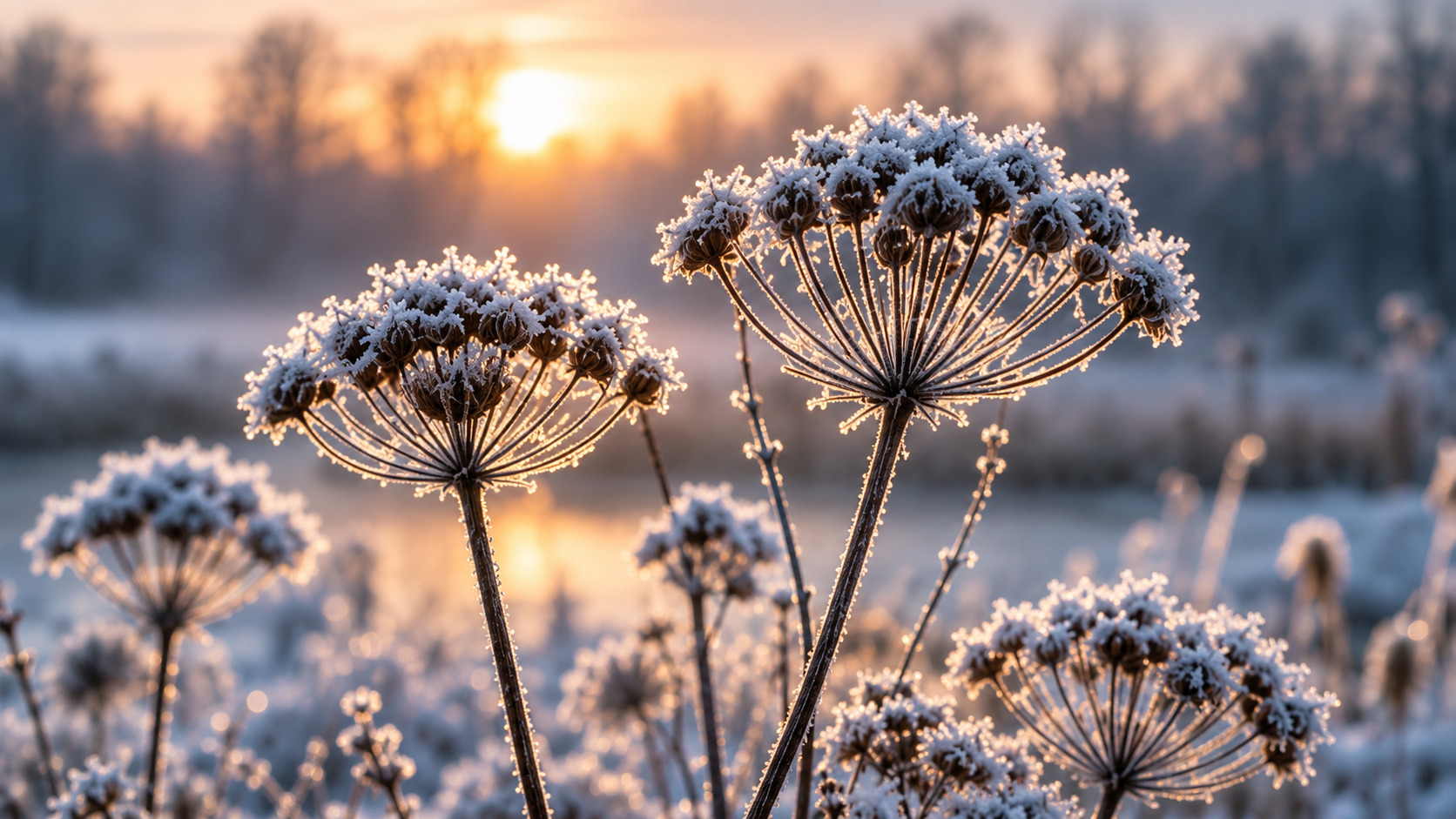
The effect can be particularly striking when the low sun illuminates dried grasses, copper leaves or frost-covered seed heads.
But winter light is not always golden.
Under a heavily overcast sky, the light becomes more diffuse, reducing strong shadows and creating a softer, more muted palette.
Greys, silvers, blues and subtle greens may become more apparent.
A landscape that glows warmly in the sunshine can appear almost monochromatic beneath cloud.
Neither appearance is more beautiful than the other.
They simply reveal different qualities of the same place.
The Many Colours of Frost
Frost is one of winter's most remarkable transformations.
On clear, cold nights, surfaces can lose heat through radiation and become colder than the surrounding air.
When conditions are right, water vapour deposits directly onto these surfaces as ice, forming delicate frost crystals.
These crystals can create extraordinary structures along leaves, stems, grasses and branches.
Frost itself is usually colourless or translucent. Its familiar white appearance results from the way numerous tiny ice crystals scatter light.
But frost does far more than turn the landscape white.
It changes how we perceive the colours beneath it.
A brown leaf may appear edged in silver. A dark twig becomes outlined in white. A seed head that might otherwise go unnoticed suddenly becomes a delicate sculpture.
In early sunlight, frost crystals can sparkle as they reflect and refract light.
Sometimes they appear golden. At other times they take on cool blue or silvery tones, depending on the surrounding light and shadows.
And then, as the temperature rises, the frost disappears.
The transformation may last only a few hours.
Perhaps that is part of its beauty.
It invites us to appreciate something that cannot be held onto.
Winter's Quiet Greens
Although many plants lose their leaves in winter, others remain green throughout the year.
Evergreens provide an important visual contrast to the muted colours of the season.
Holly leaves have a deep, glossy green that can appear almost blue-black in shadow.
Ivy creates carpets and climbing patterns of rich green, sometimes displaying pale veins or lighter variations.
Yew foliage is often a dark, almost blackish green, while pine needles may have cooler blue-green or grey-green tones.
These differences become particularly apparent in winter, when deciduous foliage no longer dominates the landscape.
But even within a single evergreen plant, the colours are rarely uniform.
Some leaves receive more light than others. Older foliage may be darker. Moisture changes the way surfaces reflect light.
Look closely at an evergreen and you may discover many different shades of green.
What we casually describe as one colour is often a collection of subtle variations.
Why Grey Is Never Just Grey
Grey is perhaps the colour most closely associated with winter.
We speak of grey skies, grey days and grey landscapes, often as though grey were the absence of beauty.
But grey is an extraordinarily varied colour.
There is the warm grey of beech bark, the blue-grey of distant trees, the silver-grey of frost and the soft charcoal of wet stone.
A winter sky may contain shades of pearl, slate, lavender, silver and pale blue.
Clouds that appear uniformly grey from a distance can reveal remarkable variations when observed carefully.
The same is true of water.
A lake beneath a winter sky may reflect pale silver in one direction and deep charcoal in another.
Near the shore, reflections of trees may introduce greens, browns and blues.
Grey is not a single colour.
It is an entire family of colours, often containing subtle hints of others.
Perhaps our tendency to dismiss grey tells us more about our expectations than about what is actually before us.
Learning to See Differently
There is something particularly interesting about the way our minds interpret colour.
We do not experience the world as a camera simply recording everything before it.
Our brains constantly interpret sensory information, drawing on memory, expectation, context and previous experience.
This is enormously useful. It allows us to navigate a complex world without having to examine every detail afresh.
But it also means that we can overlook things that do not fit our expectations.
If we believe winter is dull and colourless, we may be less inclined to notice its subtler colours.
We look at the landscape and see what we expect to see.
Yet when we deliberately begin searching for colour, something changes.
The moss becomes greener. The bark reveals warmer tones. A fallen leaf suddenly appears copper rather than brown.
Nothing in the landscape has necessarily changed.
What has changed is our attention.
This is one of the most valuable lessons nature can offer us.
The world contains far more detail than we usually notice.
And sometimes, simply changing the way we look can transform our experience of it.
A Different Palette Every Time
One of the central invitations of The Turning Year is to return to the same places throughout the seasons.
But there is also enormous value in returning throughout a single season.
Visit the same tree on a clear frosty morning, and then again on a damp afternoon.
Notice how the colours change.
The bark that appeared pale silver beneath frost may become dark charcoal after rain.
The copper leaves that glowed in the morning sunlight may appear muted beneath cloud.
The moss may look almost luminous when wet.
Even the time of day makes a difference.
Early morning light, midday cloud and late afternoon sunshine can reveal entirely different palettes.
You might choose a particular tree, a patch of woodland, a view across the lake or even a single fallen branch.
Return regularly.
Notice what has changed.
And perhaps, just as importantly, notice what you failed to see the last time.
The more familiar we become with a place, the more we may discover within it.
An Invitation to Explore Winter's Colours
The next time you walk through a winter garden, try a simple experiment.
Rather than looking for the most beautiful view, begin looking for colours.
Choose five colours that catch your attention.
They need not be bright or unusual.
Perhaps you discover the soft green of lichen, the warm brown of an oak leaf, the purple of a twig, the silver of birch bark or the deep blue-grey of the sky.
Give each colour a name of your own.
Then consider how those colours might change under different conditions.
What would they look like in sunlight? After rain? Covered in frost?
You might even photograph the same subject on different visits and compare the colours.
But there is no need to record anything.
The experience of noticing is enough.
A Reflection to Take With You
Winter teaches us something that extends far beyond the colours of the natural world.
We often approach experiences with preconceived ideas about what they should be.
We decide that summer is beautiful and winter is bleak. That sunshine is good and rain is disappointing. That some experiences are worth having while others are merely to be endured.
And in doing so, we may overlook much of what life has to offer.
The colours of winter invite us to question those assumptions.
They remind us that beauty is not always obvious, vibrant or dramatic.
Sometimes it is quiet.
Sometimes it requires patience.
Sometimes it is found in the things we have passed a hundred times without really seeing.
And perhaps the greatest discovery is not simply that winter contains more colour than we imagined.
It is that the world has always contained more beauty than we have noticed.
The colours were there all along. We simply needed to learn to see them.
The Turning Year is an invitation to reconnect with the natural world, to notice the changing seasons and to discover the extraordinary within the ordinary.
Return often. Look again. There is always something new to discover.
The Sculpted Soul
Sculpture by the Lakes, Dorset
Return to this place on another day.
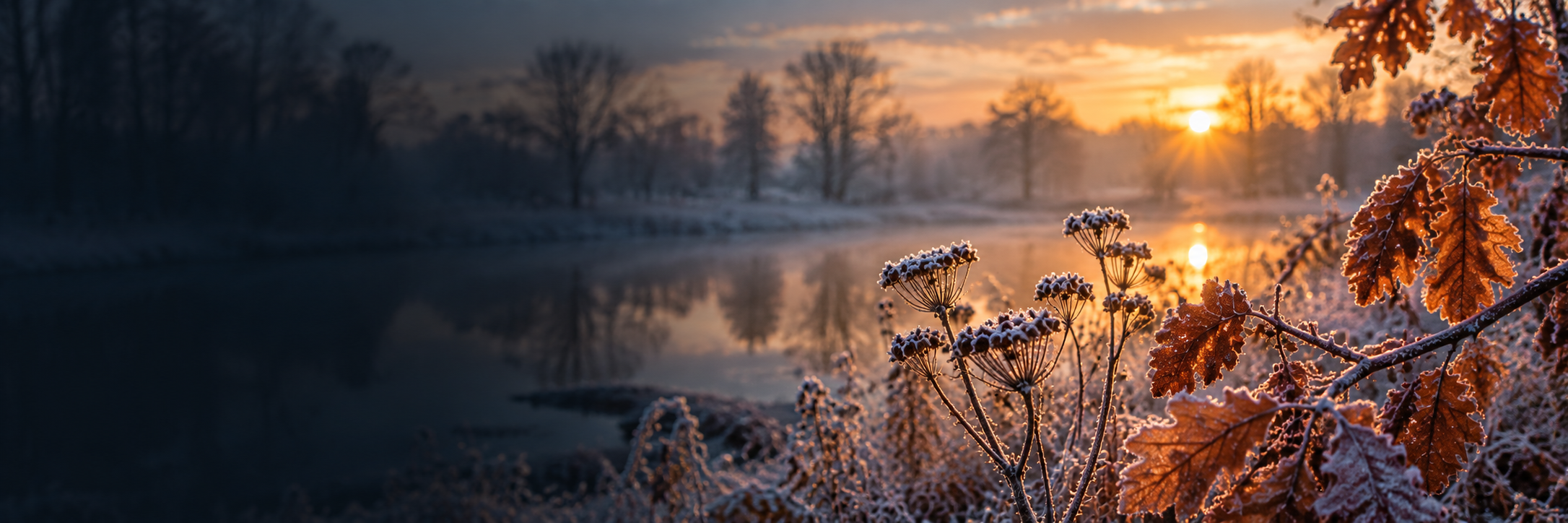
Perhaps the sky will be heavy with grey clouds, the ground silver with frost, or the trees glowing copper in the low sun.
The colours will be different each time.
And as you begin to notice more, you may discover that winter is far richer than you once imagined.
A Different Palette Every Time
Stay Connected
A Little More of The Turning Year
Receive occasional reflections, seasonal observations and invitations to spend time in nature