
The Details of Winter
A World of Small Wonders
There is a particular kind of beauty in winter that asks something different of us.
Spring announces itself with blossom and new growth. Summer surrounds us with colour and abundance. Autumn captures our attention with its extraordinary transformation of the landscape.
Winter is quieter.
The leaves have fallen, the flowers have disappeared, and much of the natural world appears to have withdrawn. We might look across a winter garden and see very little happening.
But this is often because we are looking at the whole rather than the details.
Move a little closer and another world begins to reveal itself.
The rough bark of a tree becomes a landscape of ridges, valleys and intricate patterns. A fallen leaf reveals a delicate network of veins. Tiny buds sit patiently along bare branches, already containing the beginnings of next spring's growth.
Moss forms miniature forests across stones and fallen wood. Lichens create extraordinary shapes and colours on branches that, only a few months earlier, were hidden beneath leaves.
None of these things has suddenly appeared. They were there all along.
It is our attention that has changed.
And perhaps this is one of winter's most valuable invitations: to discover how much we overlook when we believe there is nothing particularly interesting to see.
The Remarkable World of Lichens
Consider the lichens growing on the bark of a tree.
They are so familiar that we rarely give them a second thought. We might mistake them for moss or assume they are simply another kind of plant.
Yet lichens are among the most remarkable examples of cooperation in the natural world.
A lichen is not a single organism in the usual sense. It is a living association, most commonly between a fungus and a photosynthetic partner, such as a green alga or cyanobacterium.
The fungus provides much of the structure, helping to protect its partner and retain moisture. The alga or cyanobacterium uses sunlight to produce sugars through photosynthesis.
Together, they create something neither could form in quite the same way alone.
Some lichens grow as flat crusts tightly attached to rock or bark. Others form delicate, leaf-like structures. Some resemble tiny branching shrubs.
Their colours range from pale silver-grey and soft green to vivid yellow, orange and almost black.
Many grow extraordinarily slowly, sometimes only a few millimetres each year. Some individual lichens may survive for centuries, while certain species in suitable environments can persist for much longer.
They can also tell us something about the environment. Because many lichens absorb water and nutrients directly from their surroundings, some species are particularly sensitive to air pollution. The kinds of lichens growing in a place can therefore provide clues about local air quality.
There is something rather wonderful about this.
An organism we might pass without noticing is actually a complex living partnership, quietly responding to its environment and participating in the wider ecology of the garden.
Once we understand a little more about lichens, we can never quite look at them in the same way again.
And this is one of the gifts of curiosity.
Knowledge does not have to take away the mystery of nature. Sometimes it deepens it.
The Architecture of What Remains
Winter also reveals the structures that summer's abundance often conceals.
Look at a dried seed head.
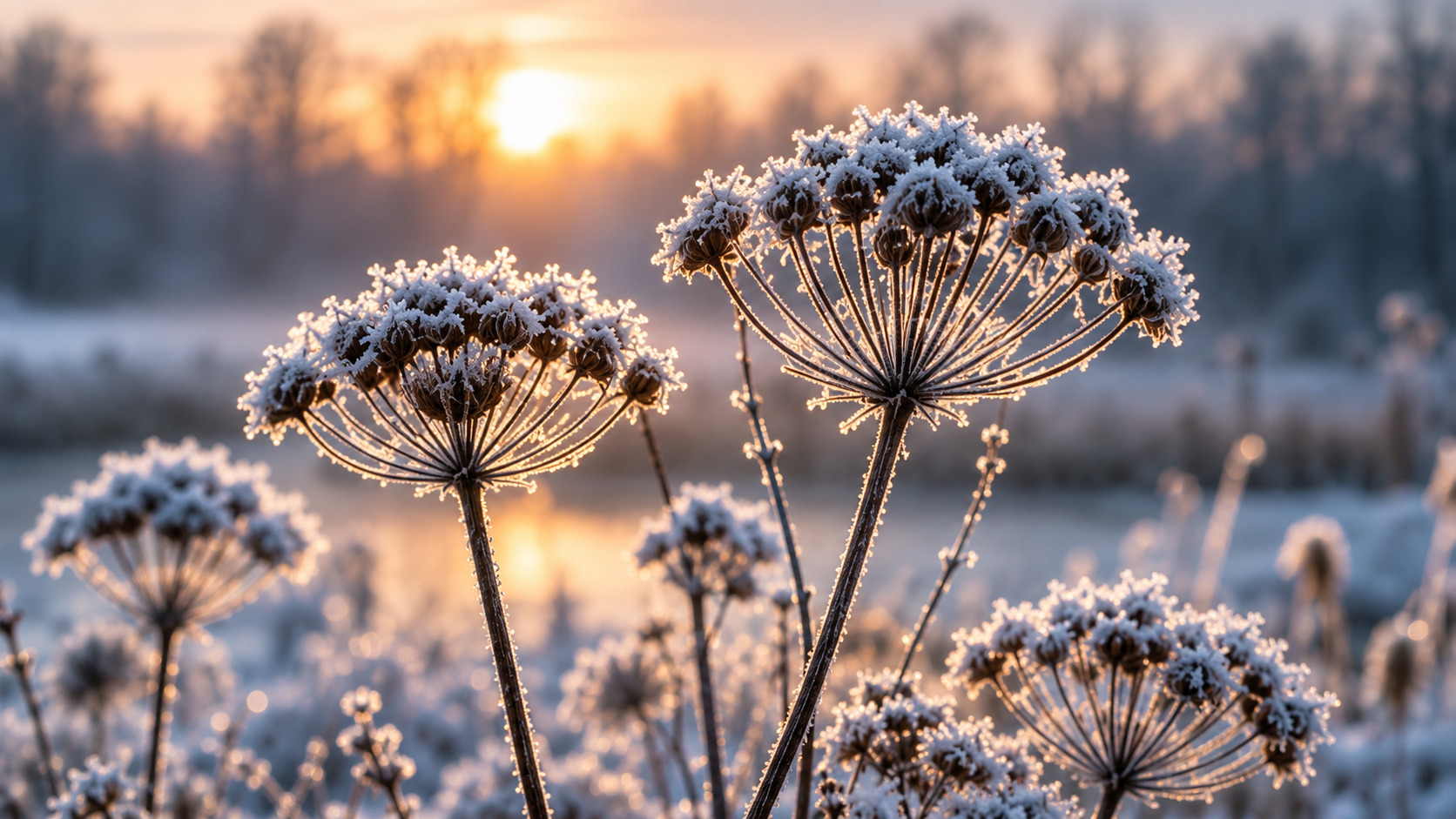
The flower may have disappeared months ago, yet its architecture remains. Fine stems radiate from a central point, forming intricate patterns of symmetry and repetition.
The seed head of wild carrot resembles a delicate umbrella, sometimes curling inward as it dries. Teasels stand upright with their distinctive spiny forms, providing food for birds such as goldfinches. The dried heads of grasses catch the low winter sunlight, revealing details that are almost invisible at other times of year.
These structures are not merely decorative.
They are the remnants of processes through which plants have flowered, reproduced and dispersed their seeds.
What we see as beauty is also evidence of life's extraordinary ingenuity.
Consider a fallen leaf.
When it first emerges in spring, it is soft and delicate. Throughout summer, it captures sunlight, helping the tree produce the energy it needs to grow and survive.
In autumn, as the tree prepares for winter, chlorophyll breaks down and many leaves change colour before falling.
Once on the ground, the leaf begins another transformation.
Fungi, bacteria and small invertebrates gradually break down its tissues, returning nutrients to the soil. The leaf becomes part of the processes that sustain future growth.
Sometimes, as the softer tissues disappear, a delicate skeleton of veins remains.
What appears to be the end of something is also part of the beginning of something else.
In nature, very little exists in isolation. Everything participates in processes of exchange and transformation.
And the closer we look, the more these connections begin to reveal themselves.
Learning to See Rather Than Simply Look
There is a difference between looking and seeing.
We can walk through a garden and look at hundreds of things without really noticing any of them.
Our minds are remarkably efficient at recognising familiar objects. We see a tree and immediately identify it as a tree. We see a leaf and recognise it as a leaf.
Once we have given something a name, we often stop paying attention.
The mind has decided that it already knows what it is looking at.
But naming something is not the same as experiencing it.
Imagine finding a small, weathered leaf on the ground.
At first, you might see nothing particularly interesting.
Now give it your full attention.
Notice its outline. Is it symmetrical? Are its edges smooth or irregular?
Follow the central vein as it branches into smaller and smaller networks.
Look at the subtle variations in colour. Perhaps there are shades of amber, bronze, grey and deep brown.
Notice the places where the leaf has begun to decay, where tiny holes have formed, or where the surface has curled.
What appeared to be an ordinary brown leaf becomes a world of extraordinary complexity.
Nothing about the leaf has changed.
Only the quality of your attention.
This is an important distinction, because much of our experience of life depends not simply on what is happening around us, but on what we notice.
When our attention is constantly occupied by thoughts about the past or concerns about the future, we can miss much of what is happening in front of us.
The natural world offers us a gentle way of returning to the present.
We do not have to force our minds into silence.
We can simply become interested in what is here.
Curiosity Changes Everything
There is another quality that makes this kind of observation particularly valuable.
Curiosity.
When we approach something with curiosity, we temporarily set aside the assumption that we already understand it.
Instead of asking, "What is this?" and being satisfied with a familiar label, we begin asking different questions.
Why does this pattern form?
How did this tiny structure develop?
What purpose might it serve?
What else is happening here that I have not yet noticed?
Curiosity changes our relationship with the world.
We become less concerned with categorising our experiences and more interested in exploring them.
And this openness can extend beyond the natural world.
We often approach people, situations and even ourselves with established ideas about what we know.
We carry assumptions formed through previous experiences. We expect familiar patterns to repeat themselves.
Sometimes these expectations prevent us from noticing what is actually happening.
Just as we might walk past a familiar tree without seeing its extraordinary details, we can move through our daily lives without recognising the richness of what is immediately available to us.
Curiosity invites us to look again.
Not necessarily to find something new, but to discover something we have never noticed before.
The Extraordinary in the Ordinary
We are often drawn towards exceptional experiences.
A spectacular sunset. A magnificent mountain landscape. An extraordinary journey.
There is nothing wrong with seeking beauty and wonder in these moments.
But if we believe that wonder exists only in the exceptional, we risk overlooking much of our lives.
Most of our days are made up of ordinary experiences.
Walking along a familiar path. Looking out of a window. Passing the same trees and plants. Feeling the changing air against our skin.
These moments may seem unremarkable because they are familiar.
Yet familiarity does not make something less extraordinary.
Consider the simple act of seeing a leaf.
Light reflected from its surface enters our eyes. The retina converts that light into electrical signals, which travel through the visual system. Our brain processes this information, allowing us to experience shape, colour, depth and texture.
All of this happens without any conscious effort on our part.
We rarely stop to consider how remarkable it is that we can experience the world at all.
The beauty of a leaf is one thing.
The extraordinary fact that we are here, able to perceive its beauty, is something else entirely.
And perhaps this is where close observation can lead us.
Beyond appreciation of the object itself, towards a deeper appreciation of the experience of being alive.
A Different Detail Every Time
One of the central invitations of The Turning Year is to return.
To revisit familiar places as the seasons unfold, noticing both the changes in the natural world and the changes in ourselves.
The Details of Winter offers a particularly simple way to practise this.
Choose a small area of the garden.
It might be the bark of a tree, a patch of moss, a cluster of seed heads or the ground beneath a favourite tree.
Spend a few minutes looking closely.
Then return another day.
Perhaps the frost has disappeared. Perhaps rain has deepened the colours of the moss. A bud may have swollen, a seed head may have lost its remaining seeds, or a fallen leaf may have begun to break down.
But something else may happen.
You might discover a detail that was there on your first visit but which you simply did not notice.
This is an important part of the experience.
We often assume that returning to the same place means seeing the same things.
Yet every visit is different.
The light changes. The weather changes. The natural world continues its transformations.
And we change too.
Our mood, our thoughts, our energy and our willingness to pay attention all influence what we experience.
The place may be familiar, but the moment is always new.
An Invitation to Look Again
Before continuing your walk, choose one small thing.
A fallen leaf. A piece of bark. A stone. A seed head. A patch of moss.
Something you would normally pass without a second glance.
Give it a minute or two of your attention.
First, notice its overall shape.
Then begin exploring its patterns, colours and textures.
Look a little closer still.
What can you see now that you did not notice at first?
You do not need to identify it. You do not need to understand its purpose or know its name.
Simply allow yourself to become curious.
And when you are ready to move on, consider one final question:
What else in my life might I be overlooking simply because it has become familiar?
There is no need to search for an answer.
Just carry the question with you.
Winter reminds us that beauty does not always announce itself.
Sometimes it waits quietly in the smallest details, inviting us to slow down, look again and rediscover the extraordinary world that has been here all along.
The more often we return, the more we begin to notice.
The Turning Year — The Sculpted Soul
An invitation to reconnect with the natural world, rediscover the richness of everyday experience and live more fully within the changing seasons.
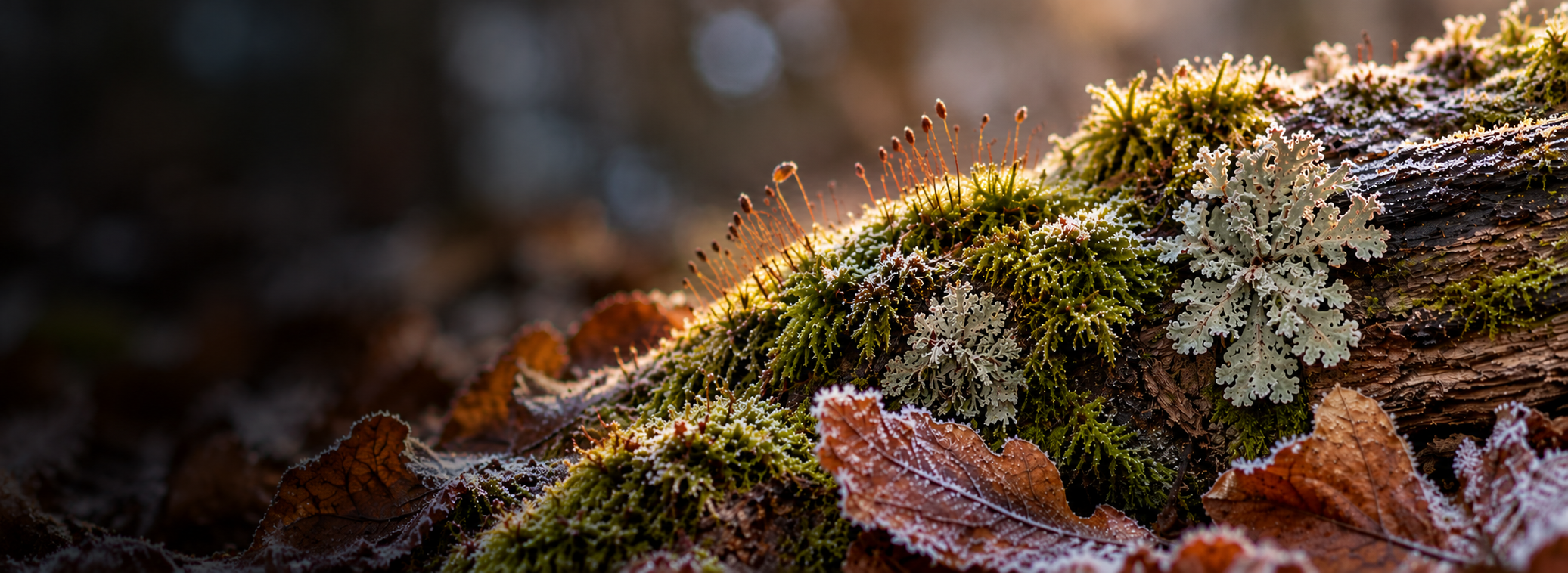
Return to the same place another day, another week or another month.
Perhaps a bud will have swollen, a seed head will have lost its seeds, or the colours of a patch of moss will appear brighter after rain.
You might even discover something that was there all along, waiting for you to notice it.
The more often you return, the more you begin to see
A Different Detail Every Time
Stay Connected
A Little More of The Turning Year
Receive occasional reflections, seasonal observations and invitations to spend time in nature